Showing posts with label science. Show all posts

Sunday, September 29, 2019

Childhood Dreams: Visiting Biosphere 2


I remember getting PBS-inspired 3-2-1 Contact magazine in the mail.  Actually "young" for the show's recommended age, I watched with both fascination and pride.  I read an article about the initial Biosphere 2 project -- 8 scientists about to be locked in to an enclosed, self-sustaining habitat in the Southwest.  Those scientists inspired me -- I wanted to be a Biospherian the same way I wanted to be an astronaut.  The attraction is magnetic.

Fast forward a few decades, and I find myself in Arizona, awaiting a tour of Biosphere 2 from an animated educational psychology graduate student.  He's working to understand how we learn scientific content from informal education.  It strikes me I should recommend Colleen Dilenschneider's blog to him.

There's an opening film that's updated to include current projects, including a massive collection of data about rainforests in drought conditions and the famed Landscape Evolution Observatory (LEO).  There's an original Biospherian "apartment" on display.  But more importantly, there's a truly immersive tour that walks the space, including content on how the project was engineered, what species can be observed on site, and a dash of history of the original Biospherians.  This. Is. A. Massive. And. Stunning. Lab. I wanted my school's biotechnology students to be there with me.


The resilience so common in the desert -- and certainly part of the way the desert becomes restorative -- is apparent in Biosphere 2.  Now fascinated with technical education, the "technosphere" of the project, or the mechanics of its "breathing," power, and other systems, tells just as amazing of a story.


On the tour in a small group, you can even see Biosphere "lungs" (more like a diaphragm) work, essentially keeping all that glass from collapsing when the air pressure changes.  There's really nothing like it.  You'll look and wonder and ask questions.


I've been introduced as a person who asks why -- a LOT.  While that reflects a Millennial desire for purpose, it also reflects the glories of 3-2-1 Contact.  I'm not alone.

Things to Know

  • This trip is poppy approved!  If you self-identify as a science nerd (in the positive way) and/or like to make connections between disparate areas of study, this place is for you, the intellectually curious!  You do not need to know a lot about anything specific to engage in the tour, but you should think things like seeing one of two lunar greenhouses in existence (the other is in Antarctica) is cool.
  • The drive to Biosphere 2 is an easy 45 minutes from Tucson, about an hour more from Phoenix, and through "populated desert" (you'll pass a Walmart and similar).  You will venture off the main road on a dedicated road to reach the site itself.  The road is paved and all, but it beckons a little adventure.
  • You enter through the gift shop.  I was glad I bought my souvenir patch upon arrival -- the shop was closed when I returned.
  • Be prepared to walk and to spend time in varied temperatures/levels of humidity.  You will walk "down" to the Biosphere 2 site and get great views of it -- and the desert -- along the way.
  • I visited in September late in their operational day.  Crowds were scant, and we had extra time with our tour guide accordingly.  If you can visit when it is not likely to be crowded, do.  You'll have more time to linger.  Our guide advised winter holidays could be quite crowded.
  • TripAdvisor may tell you this is a "science museum," but it is really an active science site.  There are some exhibits, but not the kind that involve children punching buttons.  There are some specialized tours and some additional educational programming options, including overnights.  Similarly, you can contact the staff and plan a retreat or similar here.
  • There's a cafe, and this would be a nice picnic spot if you are up for adventure picnic -- or asking the staff if you can sit at one of the picnic tables outside.  They are a little out-of-the-way, and I'm not sure they are intended for tourists.
  • Look for possible deals on Groupon.  There are some discounts for students and the like -- but nothing like AAA.  Allot about $20 a person in admission.  I spent about 3 hours hanging around looking at exhibits and taking the typical tour.
  • Yes, mobile service is a bit spotty -- plan for it.

For Further Exploration

  • Wondering why the history of Biosphere 2 is important and what it says about our humanity?  Start at Lessons from Biosphere 2.  Think about the ambition of the early 90s in particular.
  • Planning an Arizona road trip?  That's a great idea!  You can land a Phoenix Sky Harbor International Airport from many destinations and drive around pretty easily.  For suggestions, see also Dave and Deb's Ultimate 10-Day Arizona Road Trip.  And of course, check out The Halterman Weekend's adventures in Arizona, including Phoenix, Sedona, and Montezuma Well and Castle.

Saturday, March 24, 2018

Local Science: Randolph College SciFest


J and I (K) are both educators, and we hear a lot about STEM education and its cousins, STEAM and STEM-H.  It's true that scientific thinking is important now and will be important in the future, regardless of one's chosen adult roles.  We work hard to try to help E, age 8, and G, age 4, learn various disciplines for thinking, and right now, a lot of that is about exposure to ideas and people who are passionate about them.  The Randolph College SciFest, an annual event including Science Day for kids, has become a favorite way to encourage E.  By next year, it might be a good fit for G, too.

When E realized we were headed to Science Day, he remembered his first trip last year and building cool boats to carry pennies fondly.  He was eager to get in place and explore this year's topics, which, from observation of the gym, included connections to archaeology, math, and earth and space science quite clearly.  Science Day features a rotation of such activities lasting about 4 hours and allowing kids to mingle with new friends (or the friends they brought with them).  It's like a combination of the best of the interactivity of science classrooms/labs and science museums.  It's not as intense or themed as a science camp, but the quality of activities is similar.


Honestly, I (K) had not been to the Randolph College campus before, so SciFest has become a great excuse to go.  One of my very bright faculty members is a Randolph grad, and the campus consistently presents as encouraging academics and true community.  (While I certainly recognize the importance of college athletics and social life, I prefer campuses that don't overemphasize these elements of the college experience.)  The students at Science Day are diverse, energetic, and thoughtful--way to represent, Randolph!  They also keep a good handle on the kids while preserving a fun atmosphere.

If you go to Science Day, know that a parent/guardian must stay present on campus.  You can visit the well-regarded Maier Museum's art collection and engage in similar activities, like a campus tour, or you can be like me and sit in the stands and do some homework, although I know I must take in the Maier Museum soon.  The generosity of area businesses provides the kids materials, T-shirts, and snacks.  If you are interested in going next year, start following I Love Randolph Science on Facebook and watch for registration dates--this amazing FREE event often fills up.  On event day, dress comfortably for inside and outside activities and arrive about an hour before start for the best parking choices.  More interested in the Roanoke area?  Try the Virginia Tech Science Festival and/or Senses and Scienceability at Jefferson College. We also like to think of college campuses as wonderful places to go for a walk/access interesting events, and we've visited Washington and Lee, VMI, Roanoke College, and Hollins College particularly.

Sunday, August 27, 2017

Totality!: Congaree National Park and Newberry, SC, for the Great American Eclipse

A reasonably close by total solar eclipse?  Well, that is a definite reason for a E and K road trip!  We took off for upstate South Carolina, visiting Congaree National Park along the way.


Congaree National Park was a great destination.  E quickly gave it five stars for a wonderfully easy-and-interesting hike along its boardwalk, affording outstanding glimpses of old cypress trees, cypress "knees," golden orb spiders, and other natural delights.  K finds "swamps" fascinating, and this was no exception.  There's a small visitor's center, decked out for the eclipse on our visit, with interpretive exhibits that highlight the conservation of the area in particular.  From the center, it's easy to catch a brief interpretive hike that will get you started with a rich experience on the boardwalk.  This is another fine park site for Every Kid in a Park--the boardwalk loop trail is easy to take with kids, and the Junior Ranger badge tasks are accessible and interesting.  


As the highlight of our trip, we enjoyed totality for the 2017 Great American Eclipse in the small South Carolina town of Newberry for Newberry Eclipse Fest.  Newberry itself is a nifty treasure of a town--and truly extremely friendly.  The residents did a fabulous job making sure everything was prepared and safe for a ton of visitors, and they set a great tone in being exceedingly welcoming to visitors.  We met great people from Maryland, New Jersey, and South Carolina; supported a fundraiser lemonade stand; spent a ton of time in festival bounce houses (well, E did); got a book signed by an astronaut; and generally hung out in a great, safe atmosphere.  We'd highly recommend your any day visit to Newberry--they have a beautiful opera house that hosts an impressive performance series spanning bluegrass to contemporary "circus-style" acrobatics.  They are also delightfully close to various National Park Service sites and other natural and cultural treasures, including being about a half-hour from Ninety Six National Historic Site (a Revolutionary War site) and locally-recommended Musgrove Mill State Historic Site (also a Revolutionary War site).  Really, Newberry is not that far from Greenville, SC, either.  In short, Newberry fully impressed us, and we will be back. (For photos of the eclipse in Newberry, click here and check out their Facebook pages for both the town and the Eclipse Fest.)

If you go out Eclipse-ing in 2024 (or at any other point), E and I would highly recommend heading for totality.  We'd been told our hometown Roanoke, VA, would be much darker than it really was, and we were so pleased with our decision to "move to totality."  Definitely consider planning to be at a well-interpreted National Park Service site and/or in a small town, and keep a special eye to where the NASA folks are--they, unsurprisingly, know what they are doing when it comes to celestial events.  Book early and take more than one set of eclipse glasses per person--you can share them or have a spare if you get a scratch.  Expect lots of roller-coaster style screaming during totality--it really is spectacular and awe-inspiring, creating diamonds in the sky.  Do bring a generous spirit for crowds, a full tank of gas, food and drinks you can keep with you in your car, and similar "think ahead" travel provisions.  Trust us, it will all be worth it.

Sunday, January 15, 2017

Making Anew: Expanded Creative Spaces at Science Museum of Western Virginia


As all our friends know, we are proud Roanoke-based members of the Science Museum of Western Virginia.  They've recently rehabbed some spaces, making more room for creativity and interaction.  Specifically,  there's a kid-oriented maker lab, a wonderful new area for designing Big Blue Blocks creations and ball tracks, and a space for toying with robots and other coding "toys."  In two cases, these areas resemble similar spaces we've adored at Marbles and Amazement Square.  They are smaller, but they are here at home and we adore them, too!  In the case of the robotic coding toys, Science Museum of Western Virginia for the win--first exhibit of its type that we've seen!

Let's start with the showstopper in the eyes of educator K--Wonderlab, a space for exploring coding, robotics, and associated logic.  Right behind the entry desk in the former gift shop space, Wonderlab provides an exploratory area that is basically classroom size.  Multiple "toy tools" are available to explore and are appropriate beginning with the early elementary grades--and will also fascinate adults.  There are computers for doing a little Scratch coding, but it was more fun for us to manipulate Cubelets and Dot and Dash.  On the Sunday afternoon we visited, no one was around except E and his friend.  What a great time to explore!


Those cool ball tracks and that area for Big Blue Blocks creations?  It's all part of Design It! Build It! Test It!  We've played with Big Blue Blocks before at Marbles and at Greensboro Children's Museum but never in so perfect a space.  A wall-mounted grid really adds to what can be done with the blue blocks, foamy huge tinker toy-type pieces that inspire all sorts of construction.  There's also a nice magnetic wall with various tubes for ball tracks reminiscent of the same type of walls at Amazement Square, only these have more space for building.  Additionally, there's a paper plane test area.
And the Maker Lab?  It's fun, too!  Quite perfect for the early-to-mid elementary set and well-designed for visitors who adore their creations, it has a Lego wall, magnet manipulatives, straws and connectors (used to so like having these as a center as a kindergarten teacher), and similar building toys.  There are also a large number of craft supplies, giving it touches of ArtVenture from the nearby Taubman. You could always say you could "do this at home"--but you'd be buying a lot of stuff and making a mess.


If you go, we suggest bringing a friend--from 7-year-old E's perspective, this was so much fun with a similar-age guest!  Never miss the butterfly garden, even if only for a quick stop, when visiting the museum, and we spent a fair amount of time in Pixel Play as well, especially enjoying the multi-player Gauntlet game.  When visiting Center in the Square, never miss a quick visit to the roof, a great place to enjoy a brought-with-you snack in fair weather.


Friends who ask:  THIS kind of close-to-home adventure is a big part of the reason you become a museum member--new play spaces!!  Think about it:  Sunday afternoon fun, free parking downtown, minutes from the house.  Join your local museum--especially if they are part of ASTC Passport.   There are periodic membership sales, too--watch the museum blog at their website.

Tuesday, September 13, 2016

Beautiful Spiders: An Evening with OVO

Sunday evening, K received a surprise email from the Science Museum of Western Virginia and Center in the Square.  The email offered invited guests--who I'd later learn were principally museum members and volunteers--the opportunity to attend a reception, at no cost excepting parking, celebrating Cirque du Soleil's OVO touring show and its arrival in town on Tuesday.  The insect theme worked for the science museum's connection, and the celebration was held on the Center's lovely rooftop.  What a wonderful way to end a workday!

Needless to say, G and K proudly RSVPed.  This was a low-cost, low-commitment way to introduce G to Cirque, something K felt she'd probably be fascinated by...but might be scared by if the timing was off.  She enjoys dancing and art, but it would be debatable whether or not she'd be awake and interested for a full Cirque show.  G got to attend the "fancy" party, enjoying cookies, crackers and cheese, as well as polite conversation with a new friend.


Then, G adored the main attraction, a brief performance by OVO's contortionist spiders.  She was transfixed and immediately approached them as soon as the photo op opened.  She even wanted to show the performers her pictures.


She took home flyers about the show including pictures of the "spiders' friends."  This settles it--a performance next year is likely in the cards for us.

While there, we saw flyers for a membership promotion from this our home science museum.  The ASTC Passport "add on" is free for the month of September when you purchase a membership with the Science Museum of Western Virginia.  Local parents willing to travel to nearby museums included in passport (translation: reciprocal membership, AKA free) museums like the Museum of Life + Science in Durham and Marbles Children's Museum in Raleigh, this is a great deal.  You do not have to live in Roanoke to join Roanoke's museum, but keep in mind ASTC reciprocity "kicks in" 90 miles from your "home" museum.  ASTC museums include many science centers, some children's museums, and some other nifty places, like the North Carolina Museum of Transportation.  Other places we've been on ASTC Passport?  Danville Science Center, Virginia Museum of Natural History, Virginia Living History, Science Museum of Virginia, and Whitaker Center.  For folks who travel with kids, this is a DEAL for most.  Look at the ASTC list for places that you might be near across the next year!

Saturday, July 9, 2016

Another Make-a-Day-of-It Museum: Durham's Museum of Life and Science

On a road trip with friends, we went to Durham, NC's Museum of Life and Science, an expansive indoor/outdoor museum campus that's great for kids approximately age 12 and under. In fact, we were there around 4-5 hours, and we probably covered somewhere between 1/3 and 1/2 of it.  This would make it a great pick for a membership museum--so if you live in Raleigh/Durham, we'd suggest that!  If you are from out of town like us, an ASTC Passport will get you in.  Our kids, ranging in age from 3-9, all had a delightful time.

We came for Hideaway Woods, the fantastic new complex of treehouses, and found a lot more. 


G, age 3, recommends the train ride (purchase tickets for $3-$4 each ride when you check in at the front desk); E, age 7, recommends the sailboats at Catch the Wind.  The adults in our group found Into the Mist, a unique misting/playing area, pretty magical. 


There are also bears, wolves, and darling lemurs, and in several cases, these exhibits have video cameras you can control so that you can see the animals when they are in more secluded exhibit spaces.


The outside area is pleasantly peppered with small indoor attractions like a butterfly garden and a particularly accessible insect zoo. We played in the Hideaway Woods creek and the adjacent playground just before our 3-hour drive home, which was a good move.


If you go, dress for the outside weather--and consider bringing a change of clothes/shoes for kids.  Wear clothing that can get dirty/wet and shoes that can climb. It's fine to pack in some food and drink in single-serving containers, and Sprout, the café inside, is a good place to eat as well.  Expect walking, and if taking in a stroller, take in one that can "off road" if you have it.  We didn't know much about Durham, NC, but we were pleasantly surprised by a variety of things to do, so go to TripAdvisor and take a look.  It's a city worth your time!

Friday, July 1, 2016

Science Reinvented: Science Museum of Virginia, Richmond


Recently, we were in Richmond for a special event (congratulations new Lay Ecclesiastical Minister Melissa!) and decided to exercise our ASTC Passport membership again and visit the Science Museum of Virginia.  It had been a long time since I'd visited--probably honestly since the 1990s--and I'd heard they'd done some renovations including some updates this year.  The museum had a decidedly fresher look--and better yet, it was a ton of fun.

Visitors are immediately welcomed to the highly-interactive Speed gallery, a new set of exhibits that feature physics concepts in a way that engages most everyone.  Well-staffed by volunteers and others, the gallery allows visitors to race virtual mice and to play table hockey with a robot.  As we were told, the robot, advantaged with calculations about trajectories, always wins.  In the same gallery, there's a new Science on a Sphere theatre, and the presentation there, included in the cost of admission, was fuller and more interactive than any similar presentation we've seen.  For E, it was great fun to see the sphere "become" various planets he's studied.

Other areas in the museum include a small collection of living specimens including snakes and spiders and an interesting (if a bit more worn) exhibit about the human body.  We also enjoyed a brief performance of trained rats playing basketball.  Yes, you read that correctly, and any adult who has ever completed a behavioral science class of any kind shouldn't miss it...and the kids still find it funny.  We didn't explore the full museum--there are other exhibits and, for additional charge, Dome theatre movies.  If travelling with younger kids, don't miss LightSpace, the new exploratory area downstairs for those 5ish and under.  There's a place to climb!  The only drawback is that the area is not gated, which can complicate supervision.  While at the museum, visit the outdoor area where the trains in this restored stations used to arrive.  It's easy to imagine the glamour of travel in another century there among the platforms, a fabulous possible event venue.  Don't worry, previous visitors--the giant pendulum still hangs in the 5-story rotunda!

If you go, know you are very, very close to the Children's Museum of Richmond's Broad Street location, a fun stop for the littles, and are also conveniently beside a McDonald's if you are feeling fast food. There are also picnic tables available at the back of the science museum's outdoor area. If you will be travelling back west on I-64 later, stop at Tom Leonard's Farmers Market on the way home.  It's just plain cute--and there tend to be free samples of good food and solid deals on local produce.


Saturday, January 30, 2016

Fun with Friends and a New Exhibit: Danville Science Center


What do you do on the next-to-last day of your ASTC Passport-level science museum membership?  1) Make sure it is renewed for next year (it is!).  2)  Enjoy the benefits with a guest good friend!  Today, E, his friend L, and Kim drove down to Danville Science Center to enjoy pleasant weather, a new travelling exhibit, and the Dome Theater movie of choice, National Geographic's Wildest Weather in the Solar System.

First things first:  Three big thumbs up to the travelling exhibit Design Zone, in-house through spring 2016.  These six-year-old boys spent well over an hour in the exhibit, and they didn't even notice they didn't cover but about a third of it.  It may be implied by that last statement, but the experienced museum-goer knows to spell out these important facts: the exhibit components were interactive, in good repair, and very engaging.  Most appropriate for early elementary through middle school, Design Zone lets you test lots of maker concepts and play games--and the connections to basic algebra, simple machines, and the like are thoughtfully designed.  It would be a fantastic field trip classroom!  Our favorite exhibits were roller coaster and skate park test tracks, both digital and physical; a three-person "bike race" activity; a catapult tester; and a marble maze game you could customize with simple equations.  Also intriguing: an equation balancing activity, coordinate plane drawing (that requires cooperation between partners); and "laser lights" to manipulate, dance-floor style.  In short, if you live where we do, it is completely worth the drive from Roanoke. By way of really nifty memories, we were also the first non-museum folks to enter the exhibit, which made us feel like celebrities.

All that said, the rest of the museum was equally pleasing.  Our other favorites included the taxidermied animal collection in the train station building and the force experiment stations upstairs. We enjoyed our Dome movie--and in Danville, there's a short planetarium "sky show" at the end of the movies.  In about 45 minutes, we saw our feature and had an educational presentation about the area sky.  Our "sky guide" was very well-spoken and informative--and the information he presented was accessible to everyone in the audience.  The technology in the Dome allows various perspectives on sky views, including the ability to "zoom out" to the Milky Way--educational, yes, and also just plain cool.

For families and collections of young friends, this museum is a great choice.  The size is big enough but not overwhelming for a day trip visit, gift shop prices are reasonable, parking is convenient, and there's an area inside for snacking/picnicking if you please.  And another plug for ASTC museum memberships:  Danville Science Center memberships are particularly reasonably priced, and you don't have to live in Danville to get them.  The ASTC reciprocity piece "kicks in" 90 miles from your home museum, so this option may be a particularly good deal in Danville depending on your family's travel plans.  They also have educator memberships, so if you work for schools, ask questions and see what works out best for you!  When getting a membership, be sure to ask about its passport status.  For more on our previous adventures at the center, click here.

Sunday, September 20, 2015

Greensboro Science Center: Good Deal, Day of Fun

K, E, G, and family friend A took off for the Greensboro Science Center in Greensboro, NC, a perfect distance from Roanoke for a day trip.  Recently renovated, the center includes a zoo, an aquarium, and a science museum with play area.  It's all very attractively presented, and on the weekends, we found lots of competent teen volunteers able to provide some interpretation.

For the zoo,  think "bigger than Mill Mountain but smaller than Asheboro; for the aquarium, bigger than aquatics in  Roanoke but smaller than Chattanooga; for the museum itself, around the size of the Virginia Museum of Natural History in Martinsville.  This all combines to make a very manageable day for young kids.  We adored the pneumatic tubes in the play area, the tigers in the zoo, and the expansive sting ray touch tank. Taking bigger kids?  Consider the Skywild aerial ropes course add on (must be at least 10 and 70 pounds).  E and A enjoyed an add-on dome theater show about stars.

If you go, know you can pack a picnic--there are tables in the zoo and at Greensboro's Country Park (it literally backs into the property).  There's a fountain you can play in and animals to pet at the zoo, too.  The public park also has playgrounds and paddleboats.  Educators, take your ID--basic admission to the center is free.  ASTC Passport holders are also free, or if based regionally, discounted.   We were able to combine both programs for a great deal.  You may come and go, using your receipt for re-entry.

Saturday, April 25, 2015

Still More Science Fun: Whitaker Center, Harrisburg, PA


On a recent family trip to Gettysburg, Pennsylvania, Kim, E, and G explored "up the road" to Harrisburg.  Again armed with our ASTC Passport science museum membership, we found the Whitaker Center.  A broad-based center with arts programming as well, we focused our visit on the Harsco Science Center and had a great time.

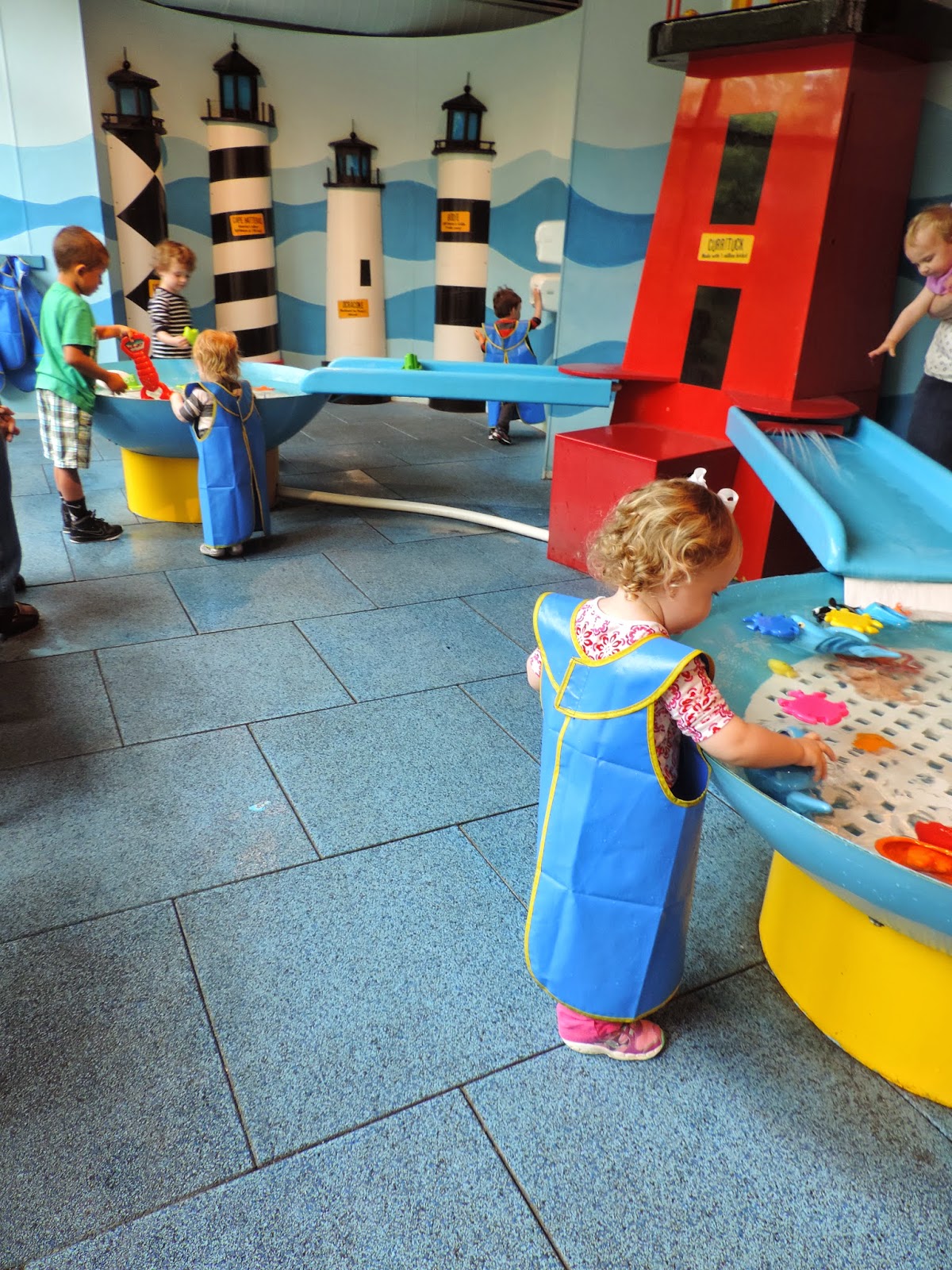
This museum is yet another beautiful science center with 3 floors of exhibits, most of which are highly interactive.  As an educator, Kim would recommend the bulk of the center for ages 7-13 for field trip planning purposes, but E, then 5, and G, then almost 2, had a blast interacting with the displays and learned content as well.  If you are familiar with Pennsylvania, you'll appreciate the connections to the state.  For instance, Move It!, an engineering and transportation area, simulates manufacturing processes and is a great link to a trip to a nearby factory tour.  The kids' favorite activities included making and test racing cars, with E trying to beat his previous times; and Forces of Nature's hurricane chamber.  Both kids also thoroughly enjoyed the "children's museum" section of the museum, KidsPlace.  This gated section was wonderful for free play with friends we met along the way and featured a fabulous ambulance center, grocery store/market, and construction site.  In this area, you'll also find the best water table we've yet to see--and as water table connoisseurs, you should take our word on it.  The table features fountains as well as movable pipes for constructing your own fountains, embedded baby seats, multiple levels, the capability to build dams, and nearby hand dryers.  If you, too, are a little too into water tables, the Forces of Nature area also includes a water/sand table capable of simulating erosion that's similar to the one recently in the rotating exhibit area at the Virginia Museum of Natural History.

If you go, there is pay garage parking very nearby in the Walnut Center Garage.  We found parking a bit pricey (about $10 for our 2-to-3 hour visit), but the garage was very convenient to the museum--like we-didn't-have-to-go-outside-to-walk-in convenient.  The museum staff and volunteers were also very welcoming and helpful, and there were no large crowds when we visited.

A Favorite Children's Museum: Marbles Kids Museum in Raleigh, NC


If you have young kids, you are definitely going to want to visit Marbles Kids Museum in Raleigh, North Carolina!  Kim had heard of Marbles after visiting the Greensboro Children's Museum and then became quite pleased to note admission to Marbles is free to ASTC Passport holders.  We simply had to make at least one trip there this year with E, almost 6, and G, almost 2.  Yes, it's about 3 hours from home in Roanoke, but it was definitely worth it.  We are actually surprised we hadn't heard about it earlier.

Marbles features two large floors of spacious, well-kept exhibits.  On our 3-hour visit, we took in the Around Town, Idea Works, Moneypalooza, and Splash! areas.  We could have spent more time in each, and we did not cover the entire museum.  Our kids were thrilled with a firetruck setup featuring a fire pole, a large train table, lots of moving parts (simple machines, pneumatic tubes, etc.) in Moneypalooza, and opportunities to build in Idea Works.  E even used a hand saw here in a special area that allows kids to create with found objects and safe building materials.  There's lots of fun to be had in art stations, at special events (a vet and a therapy dog were there to greet kids during our visit), and more.  Expect a good crowd, and know the Around Town area is a good one for the smallest explorers--it's gated.  We highly recommend this museum for the toddler-to-early elementary school set.

In short, Marbles was one of the best children's museums we've seen. It was a great place for E and G to enjoy a playdate with their cousin R.  If you go, consider roaming the museum with a small group of similar-aged children and a couple of adults for good measure.  Admission is just $5 if you do not have membership rights; parking is nearby (pay to park in a surface lot or in a garage).  There's an IMAX theatre and restaurant on site, and you are within walking distance to the North Carolina Museum of History.  There's also an attractive museum courtyard, so if the weather cooperates, we don't know why you couldn't bring a picnic.

ASTC passport holders traveling to/from Roanoke, consider planning your visit route to incorporate the Museum of Life + Science, Greensboro Science Center, and/or other museums on the passport list--you are within driving range!  We have family in North Carolina, and we are planning more joint play date trips this year.

Monday, January 26, 2015

It's Going to Be a Year for Science Museums: Back to Martinsville for Dino Day


Kim has mentioned it before, but we are thrilled with our ASTC Travel Passport!  With it, we headed back to the Virginia Museum of Natural History in Martinsville to take in Dino Day, one of their special annual events. 

Dino Day is a "fun day" all about dinosaurs that is very accessible to elementary-aged children.  This year's event featured two animatronic dinosaurs, a dinosaur origami station, Appalachian State students chatting about their experiences on fossil digs, a balloon artist, and similar items of interest to kids.  One of the niftiest parts?  The event included a true variety of interests and even included a station where a watercolor artist created pictures of dinosaurs.  If you go, know the stations crowd the museum a bit, and we noticed crowds were thinner as the event progressed.  It is our understanding the event returns each winter for a day of fun sponsored by local industry.  While visiting, we continued to enjoy the other exhibits, spending more time in the current temporary exhibit about the role of water in Virginia on this trip.  This exhibit features a sophisticated sand/water table which Elijah and Gwen enjoyed for well over 20 minutes, and they would have stayed longer if I had let them.  To read more about our overall take on the museum, click here.  For a real throwback, see our first visit here, one of the first times Kim and Elijah went out adventuring for a mommy-and-me date.   

Saturday, January 17, 2015

Young Earth Scientists' Paradise: Virginia Museum of Natural History

It's true there have been no major troves of dinosaur fossils found in Virginia, but scientists know they were here and may find them.  Better yet for most of us, you can see dino fossils now without leaving the state if you head to the Virginia Museum of Natural History, a museum of impressive scale found in small Martinsville, Virginia.  The museum opens to the Hall of Ancient Life, the site's main hall and beautiful display area for several dino skeletons.  As Elijah pointed out, look up for the pteranodon, and don't miss going to the small exhibit area upstairs to walk the bridge and get a bird's eye view of the fossils below.  From the hall, you can also observe scientists at work in a few working labs.  As you can see from the photo of Justin, Gwen, and Elijah above, there's a lot to look at!

Other exhibits showcase many carefully taxidermied animals including river otters, prairie dogs, lions, deer, and even a mother opossum carrying her babies! Virginians are sure to appreciate the Virginia-focus of many of the displays, including information on the formation of coal, the lives of Native Americans in the region long ago, and Caroline County's fascinating Carmel Church fossil dig site.  To indulge your more worldwide Earth science interests, there's a space full of good descriptive information on plate tectonics and volcanoes.  There's also a travelling exhibit space adding variety for regular visitors.

If you are traveling with preschool or elementary-aged children, there is a small play area within the museum that includes climbing equipment.  Take note that it features some steep ladders and dress to "spot" your younger children accordingly.  Whether or not you have kids with you, go to the basement classroom-style space--interesting leafcutter ants and other live specimens are on display there.

If you live in southwest or central Virginia, we recommend you check out the passport-level family museum memberships currently available at a discounted rate at the Science Museum of Western Virginia.  The Association of Science-Technology Centers (ASTC) passport feature results in an impressive list of "free" museums and other cultural sites in Virginia and North Carolina in particular, including the Virginia Museum of Natural History.  We plan to be repeat visitors this year--and in warmer weather, we want to also take in nearby Fairy Stone State Park.

Relevant Twitter Handle: @VMNH

Tuesday, March 25, 2014

A New Treasure: Discovering the Danville Science Center


Inspired by a field trip at Kim's school, we headed out to the Danville Science Center--a place we'd barely heard of but thoroughly enjoyed.  The center is full of interactive exhibits and play areas--and it's worth the drive from Roanoke. 

Permanent exhibits span two buildings and include rocks, small "stuffed" animals, and a few live animals like a lizard and a turtle.  There's a large temporary exhibit space, and exhibits rotate reasonably frequently.  There are also seasonal attractions like a butterfly garden.  Elijah was a huge fan of the From Here to There temporary exhibit, enjoying the "air tubes" for moving balls very much.  Picture a large see-thru bank or pharmacy drive thru that you can control, and you'll get the idea.  This exhibit has a small "ball pit" with building toys including various simple machines (a ramp, a gear and pulley system, etc.), and both Elijah and Gwen could have stayed in it all day.  While the museum isn't as expansive as some similar museums, there was plenty for us to do--and in a visit of about three and a half hours, we didn't even make it upstairs.  This, of course, is a sign we'll have to go back.

The site itself is interesting and features a restored active train station--complete with a model layout of the city and a red caboose you can play in.  A recently-added Digital Dome Theater is prominent in the center's architecture.  On our trip, the kids took in their first such show, seeing a film about the solar system and a sky show.  We understand why the dome is advertised as the best theater of this type in the region.  The technology for the sky show was particularly impressive, and our guide was able to show us a 3-D model of our galaxy. 

If you go, expect a kid-friendly place, including a small room for snacking (bring your own) and a gift shop with low-cost items (we picked up a globe keychain for less than a quarter).  The staff spoke genuinely to the kids, which is always a friendly plus.  In fact, Kim recommends it as one of the best science museums we've been to for preschool-to-elementary aged kids.  On a warmer day, pack a picnic--there are lovely, if urban, grounds for it--and take in a walk across the river on a nearby pedestrian bridge.  Another plus?  Admission is more reasonably-priced than many similar attractions in the region.  If you live close, the center's birthday parties sound like a great deal.  On the day we visited, a group of young kids were launching toy rockets as part of their planned party activities--Elijah would love it.